In 1866 the borough erected a brick building to house equipment and hold meetings. Borough Council also met in this building for many years. The building was later sold to the Union Fire Company in July of 1946 for the cost of $4,025.00.
The 1866 engine house with the Silsby steamer, hand drawn ladder truck, and a hose cart.
On September 5, 1870, another fire company reorganization meeting was held. Meetings continued to be held on a regular basis throughout the next six years.

Fire hydrants were installed in the borough around this time. The hydrants were installed at the upper end of Main Street (now Fourth Street) and at other locations along the canal and creeks where a good water supply could be obtained. From these hydrants, every point in the borough could be reached with several hundred feet of hose. It was also around this time that a bell was installed on the engine house tower to better notify the fireman of an emergency.
On December 10, 1915 discussions were begun to go through the process of forming a beneficial Relief Association. The following year the company would purchase its first mechanized vehicle. The company purchased a 1916 Hahn chemical truck on January 14th of that year. On March 16th of that year the company began its Tuesday night training and equipment checks, a practice that remains in effect to this day. On April 9, 1920 the Beneficial Relief Association was officially incorporated, and on October 8th of that year a new electronic siren was placed atop the old bell tower to better notify both the firefighters and the community of a fire.


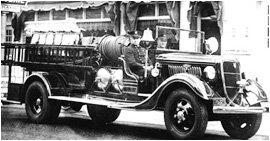

1951 Ford-Hahn pumper, with a 750 GPM pump
On May 9, 1952 the first radios were introduced into the company. One Motorola master unit, and four Motorola mobile radios were purchased at a cost of $3,195,15 (installed). The following year twenty-five call boxes were purchased to be placed in the homes of the active firemen. On May 19th telephone panels were installed for civil defense purposes. On September 11, 1953 the idea of connecting all of the Zone 2 companies was discussed. The system would have amburg as the dispatching center for the zone, which consists of Hamburg, Shartlesville, Shoemakersville, Virginville, and Leesport. The plan was never finalized however, due to lack of funding.
Having radios in the trucks made communications much better, however the Chief still did not have a radio to be able to give instructions to the arriving trucks. It would be two years later on January 4, 1955 that the chief’s personal car would be equipped with a mobile radio. Today the chief and each of the three assistant chiefs have radios in their vehicles. On May 5, 1956 the Field House was dedicated. The idea for the field house was conceived in 1953 and the facility was designed and engineered through 1953 and 1954, with ground breaking occurring in May of 1954. The Field House was first used in 1955, while still under construction. The cost of this project was $189,600.00, with no cost to the Hamburg taxpayers.
23 years later, on July 20, 1979 a special meeting was called to discuss the proposed sale of the structure to the Hahn Motor Company. The company made a proposal to purchase the building for $200,000.00. The results of the meeting were 22 yea votes and 149 nay votes.
The building stayed within the organization and is still run by the fire company. On November 9, 1956 thirty more call boxes were purchased to be placed in the homes of the firemen. These boxes were more advanced than their predecessors and were tone activated so that they would only broadcast when Hamburg received a fire call. The company made a significant investment in 1961 with the purchase of a Ford-Hahn-Grove (750/500/65) 65 foot ladder truck. The truck was equipped with a 750 gallon per minute pump, 65-foot Grove aerial ladder, and numerous ground ladders and tools. This truck would serve the company for nearly forty years, before being replaced in 2000.
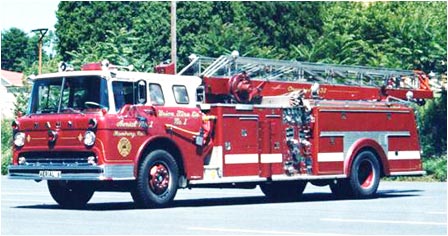
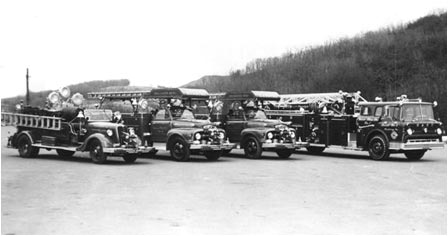

1972 (left) and 1967 (right) Ford-Hahn pumpers
On October 1, 1976 a special meeting was held for the purpose of accepting a proposal from the Pendergast family to erect a combination engine house and storage building adjacent to the existing engine house. The meeting resulted in 25 yes votes, 7 no votes, and 2 members who abstained from voting. One week later, on October 8th, a committee was formed to oversee the construction of the building. In June of 1979 plans were received and forwarded to Harrisburg for approval. The Ernst Construction Company, of Hamburg, was awarded the contract for the erection of the new building.
On April 14, 1978 a committee was appointed for the purpose of acquiring a Hurst “Jaws-of-Life” rescue tool. The first rescue tool was purchased through a combination of funds donated by local civic groups and fire company monies, and was put into service in August of 1978. Since that time the company significantly has expanded its rescue arsenal and now carries a variety of tools on different trucks, allowing for crews to work at two different accident scenes simultaneously.
In 1979 the company again looked to modernize the fleet. However, this time they were not just looking to modernize, but also to expand. A committee was formed to oversee the purchase of a new engine, and on April 12, 1980 the company purchased a 1000 GPM custom pumper from Hahn Motor Company. The 1980 Hahn, referred to as Engine 61-1, was the first truck purchased with an automatic transmission. This truck was the first-due truck for building and vehicle fires. Serving the company and community for 44 years E61-1 was retired in 2024. While other newer trucks have since been added to the fleet, none have surpassed the abilities of this classic truck. Some members have even nicknamed it “The War Wagon” because you can take it into any battle.

1980 Hahn custom pumper
As the years went on, the fire company responded to more and more car accidents. In 1986 the company purchased its first rescue truck, a 1986 Hahn truck with a Saulsbury rescue body. This truck would be the last Hahn purchased by the organization. The Hahn factory, which was located within the borough of Hamburg, would close a few years later. In 1992, the 1967 Ford Hahn was replaced with a new 2000 GPM Fire-Fox engine from Kovatch Mobile Equipment (KME). This is the largest engine owned by the company and it was designed to be a water supply engine with its large pump and 2000 feet of large diameter hose.
Two years later the 1972 Ford-Hahn would also be replaced by a KME engine. The new engine, designated Engine 61-2, was designed with a short wheelbase and four-wheel drive capabilities to allow it to operate in areas that the larger trucks traditionally could not access.
In 1997 the company expanded again, this time through the acquisition of a brush truck. The truck was gained through the Department of Conservation of Natural Resources (DCNR), which oversees the forestry crews. The truck was a 1965 Kaiser 2 ½ ton truck that was formerly used by the United States military. The unit was retrofitted with a tank, pump, and hose. In 2007 this truck was update with 1984 American General 5 ton.
By 1999, after 38 years of service, it was time to replace the Hahn ladder truck. The decision was made to purchase a new American LaFrance 100-foot aerial ladder truck. The new truck arrived in 2000 and included a 6 man, fully enclosed cab, and numerous other state of the art improvements, including two master stream devices.

The 2000 American-LaFrance 100-foot aerial ladder and it’s predecessor the 1961 65-foot aerial ladder truck
As staffing challenges arose the company realized it was in need of a multiple purpose apparatus. It was decided to purchase a 2009 American LaFrance eagle pumper to be known as Rescue Engine 6. With 850 gallons of water and the ability to carry rescue tools this would allow members to respond to a wider variety of incidents. The company took delivery of the truck in August 2010.
2009 American Lafrance Rescue-Engine
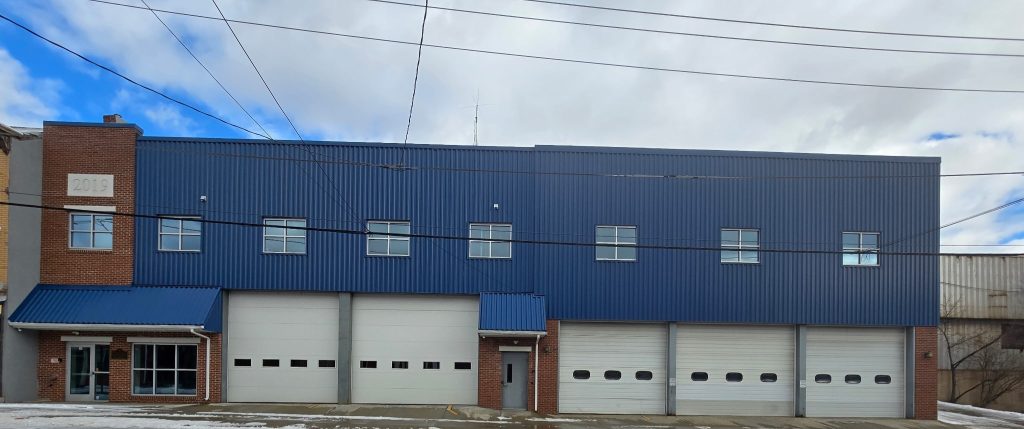
As membership and the size of the apparatus grew the company was outgrowing its current quarters. Along with modern safety features needed the company was ready to begin a building addition. With immense thought it was needed to demolish the original engine house and social quarters building to make way for a 2 story, 2 bay addition. Ground broke spring of 2019 with completion in winter 2020. This provided a dedicated meeting and training room space, office space, and crew quarters. This additional space will allow the company to continue to expand as technology and fire techniques develop for the next 175 years.